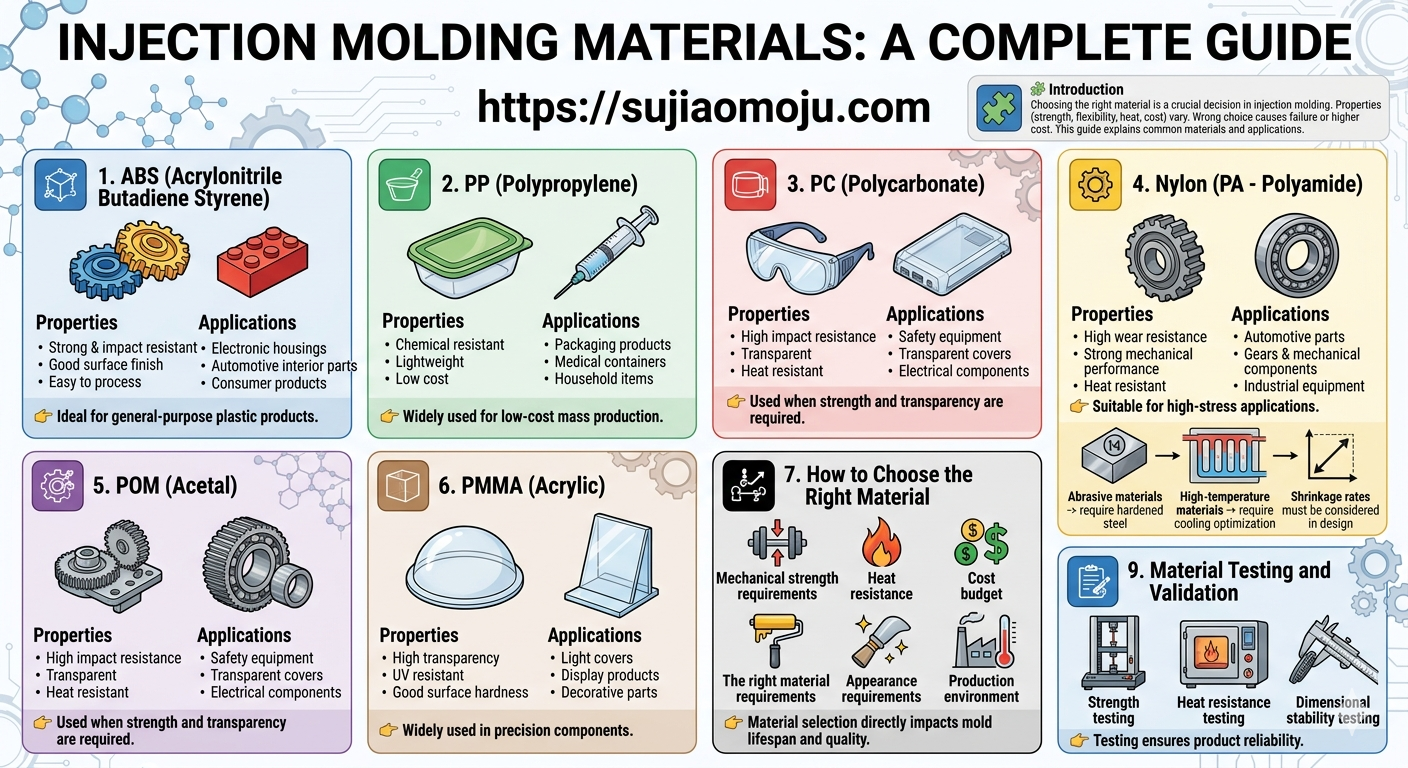
🧩 Introduction
Choosing the right material is one of the most important decisions in injection molding.
Different plastics have different properties, such as strength, flexibility, heat resistance, and cost. The wrong material selection can lead to product failure or increased manufacturing costs.
In this article, we explain the most commonly used injection molding materials and their applications.
🟦 H2:1. ABS (Acrylonitrile Butadiene Styrene)
ABS is one of the most widely used injection molding materials.
Key properties:
- Strong and impact resistant
- Good surface finish
- Easy to process
Applications:
- Electronic housings
- Automotive interior parts
- Consumer products
👉 ABS is ideal for general-purpose plastic products.
🟩 H2:2. PP (Polypropylene)
PP is a lightweight and flexible plastic material.
Key properties:
- Chemical resistant
- Lightweight
- Low cost
Applications:
- Packaging products
- Medical containers
- Household items
👉 PP is widely used for low-cost mass production.
🟥 H2:3. PC (Polycarbonate)
PC is a high-strength transparent material.
Key properties:
- High impact resistance
- Transparent
- Heat resistant
Applications:
- Safety equipment
- Transparent covers
- Electrical components
👉 PC is used when strength and transparency are required.
🟨 H2:4. Nylon (PA – Polyamide)
Nylon is an engineering plastic with high mechanical strength.
Key properties:
- High wear resistance
- Strong mechanical performance
- Heat resistant
Applications:
- Automotive parts
- Gears and mechanical components
- Industrial equipment
👉 Nylon is suitable for high-stress applications.
🟪 H2:5. POM (Acetal)
POM is a high-precision engineering plastic.
Key properties:
- Low friction
- High stiffness
- Excellent dimensional stability
Applications:
- Precision gears
- Bearings
- Mechanical parts
👉 POM is widely used in precision components.
🟫 H2:6. PMMA (Acrylic)
PMMA is a transparent plastic material.
Key properties:
- High transparency
- UV resistant
- Good surface hardness
Applications:
- Light covers
- Display products
- Decorative parts
⬛ H2:7. How to Choose the Right Injection Molding Material
When selecting materials, consider:
- Mechanical strength requirements
- Heat resistance
- Cost budget
- Appearance requirements
- Production environment
👉 The right material improves product performance and reduces cost.
🟧 H2:8. Material Selection and Mold Design
Different materials affect mold design:
- Abrasive materials require hardened steel
- High-temperature materials require cooling optimization
- Shrinkage rates must be considered in design
👉 Material selection directly impacts mold lifespan and quality.
🟦 H2:9. Material Testing and Validation
Before mass production, material testing is essential:
- Strength testing
- Heat resistance testing
- Dimensional stability testing
👉 Testing ensures product reliability.
 English
  Chinese
  Hungarian
  Polish
  Turkish
  Spanish
  Vietnamese
  Indonesian
  Arabic
  Hindi
Hindi  French
  Bengali
  Portuguese
  Russian