Introduction
The injection mold manufacturing process involves multiple precise engineering steps, from product design to final mold testing.
Understanding this process helps customers better evaluate suppliers, control project timelines, and ensure high-quality results.
In this article, we explain the complete injection mold manufacturing process step by step.
1. Product Design Review (DFM Analysis)
The first step is Design for Manufacturability (DFM) analysis.
At this stage, engineers review:
Product structure
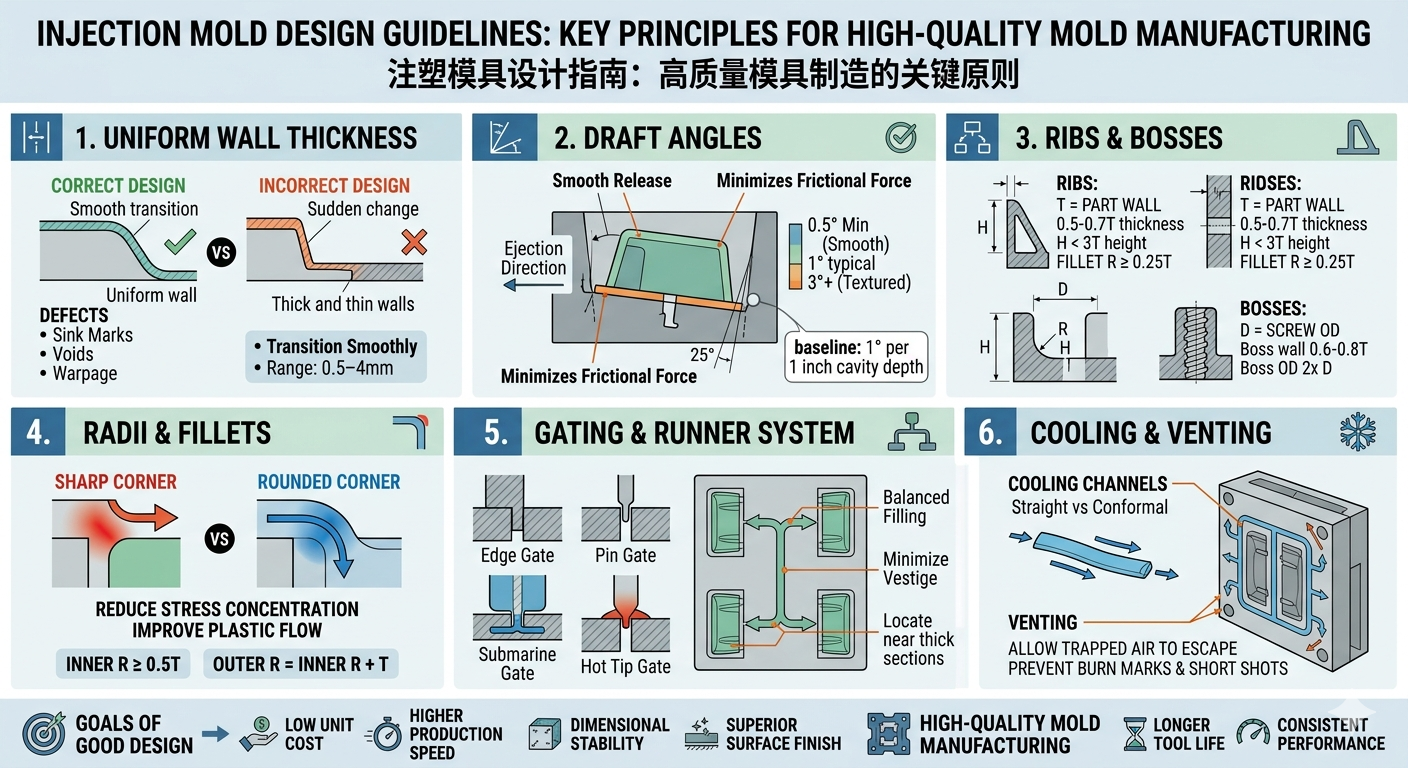
Wall thickness
Draft angles
Potential defects
👉 The goal is to optimize the design before mold production starts.
2. Mold Design
Once the product design is approved, the mold design process begins.
This includes:
Mold structure design
Gate and runner system
Cooling system layout
Ejection system design
👉 Advanced CAD/CAM software is used for precision design.
3. Material Selection and Preparation
Choosing the right mold steel is critical.
Common materials include:
P20 (standard molds)
H13 (high durability)
S136 (high precision & corrosion resistance)
👉 Material selection depends on product requirements and production volume.
4. CNC Machining
CNC machining is used to shape the mold components with high precision.
Key processes:
Rough machining
Fine machining
High-speed milling
👉 CNC ensures accurate dimensions and surface quality.
5. EDM (Electrical Discharge Machining)
EDM is used for complex shapes that cannot be achieved by CNC.
It is commonly used for:
Deep cavities
Sharp corners
Complex geometries
👉 EDM provides high precision for detailed mold features.
6. Mold Assembly
After machining, all components are assembled into a complete mold system.
This includes:
Core and cavity assembly
Cooling system installation
Ejection system setup
👉 Precision assembly ensures smooth mold operation.
7. Mold Polishing and Surface Treatment
Surface finishing is performed to improve mold quality.
Types of finishing:
Mirror polishing
Texture processing
Matte finish
👉 Surface quality directly affects final product appearance.
8. Mold Testing (T1 Trial)
T1 trial is the first test run of the mold.
During this stage:
Injection parameters are tested
Defects are checked
Adjustments are made
👉 This step ensures the mold is production-ready.
9. Mold Adjustment and Optimization
After trial testing, engineers make necessary adjustments:
Improve gate design
Adjust cooling system
Fix dimensional issues
👉 Optimization ensures stable mass production.
10. Final Inspection and Delivery
Before delivery, the mold undergoes final inspection:
Dimension accuracy check
Surface quality inspection
Functional testing
👉 Only qualified molds are shipped to customers.
 English
  Chinese
  Hungarian
  Polish
  Turkish
  Spanish
  Vietnamese
  Indonesian
  Arabic
  Hindi
Hindi  French
  Bengali
  Portuguese
  Russian