Introduction
Injection mold design is one of the most critical steps in plastic product development. A well-designed mold ensures high production efficiency, stable quality, and longer tool life.
Poor mold design, however, can lead to defects, higher costs, and production delays.
In this article, we introduce the key injection mold design guidelines that every project should follow.
1. Part Design and Geometry Optimization
A good mold starts with a well-designed part.
Key principles:
- Avoid sharp corners
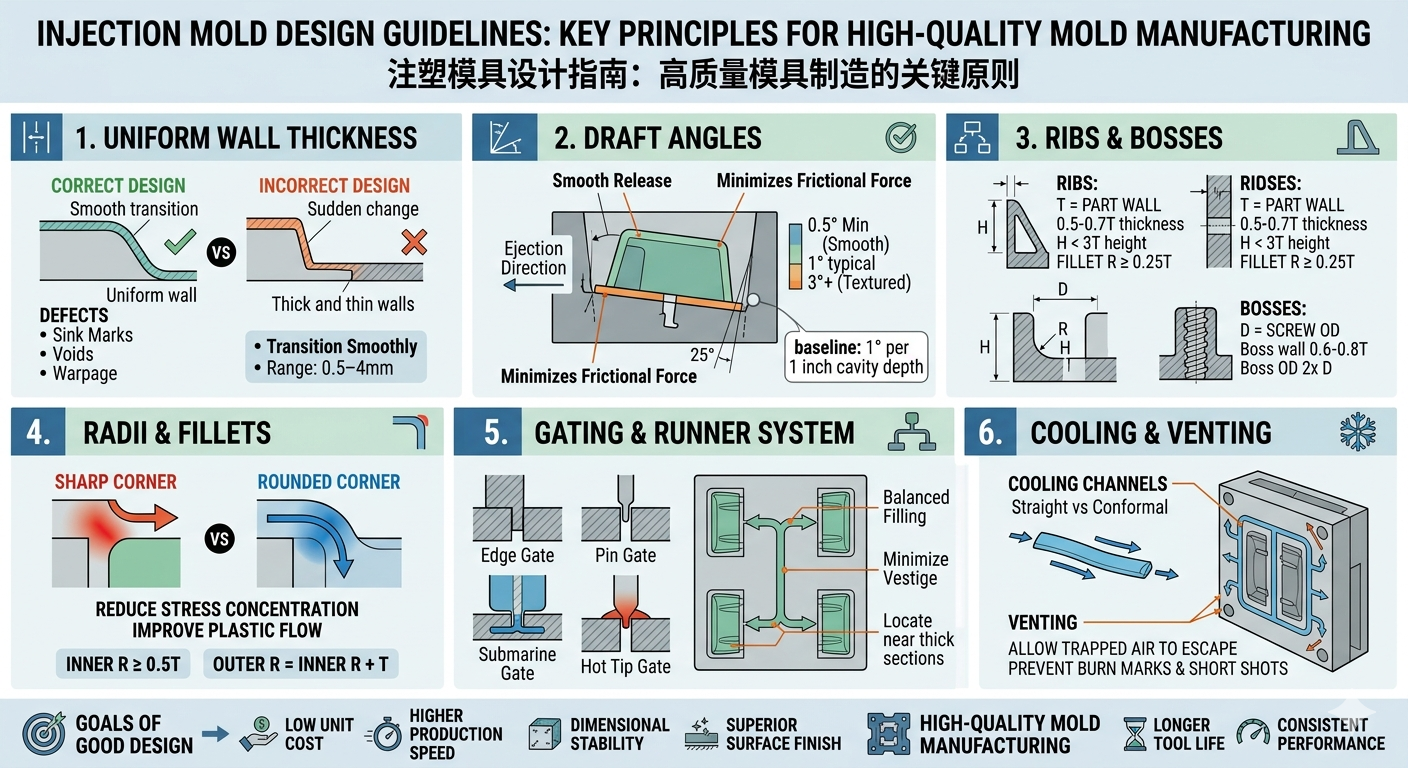
- Maintain uniform wall thickness
- Reduce unnecessary complexity
👉 Good part design reduces mold cost and improves production stability.
2. Wall Thickness Control
Consistent wall thickness is essential for stable injection molding.
- Thin walls → difficult filling
- Thick walls → shrinkage and sink marks
👉 Recommended: uniform thickness across the entire part.
3. Draft Angle Design
Draft angles allow smooth part ejection from the mold.
- Standard draft: 1°–3°
- Textured surfaces require larger angles
👉 Without proper draft, parts may stick or get damaged.
4. Gate Location Optimization
Gate design controls how plastic flows into the mold cavity.
A good gate design:
- Ensures even filling
- Reduces weld lines
- Improves surface quality
👉 Poor gate design can cause defects and weak points.
5. Cooling System Design
Cooling system is one of the most important factors in mold performance.
A well-designed cooling system:
- Reduces cycle time
- Prevents warping
- Improves production efficiency
👉 Cooling design directly affects productivity and cost.
6. Ejection System Design
The ejection system removes the finished part from the mold.
Common methods:
- Ejector pins
- Stripper plates
- Air ejection systems
👉 Improper ejection design can cause deformation or scratches.
7. Mold Material Selection
Choosing the right steel is critical for mold durability.
- P20 → general purpose molds
- H13 → high strength and heat resistance
- S136 → high precision and corrosion resistance
👉 Material affects both cost and mold lifespan.
8. Venting System Design
Proper venting is necessary to release trapped air.
Without proper venting:
- Burn marks
- Short shots
- Air traps
👉 Venting ensures complete and defect-free filling.
9. Tolerance and Precision Control
Different industries require different levels of precision:
- Automotive: medium-high precision
- Medical: very high precision
- Electronics: fine tolerance required
👉 Tight tolerance increases machining cost.
10. Design for Manufacturability (DFM)
DFM means designing parts that are easy to manufacture.
Key benefits:
- Lower mold cost
- Faster production
- Fewer defects
👉 DFM is essential before mold manufacturing starts.
 Indonesian
  Chinese
  English
  Japanese
  German
  Italian
  French
  Thai
Thai  Vietnamese
  Malay
Malay  Korean
  Hindi
Hindi  Spanish